





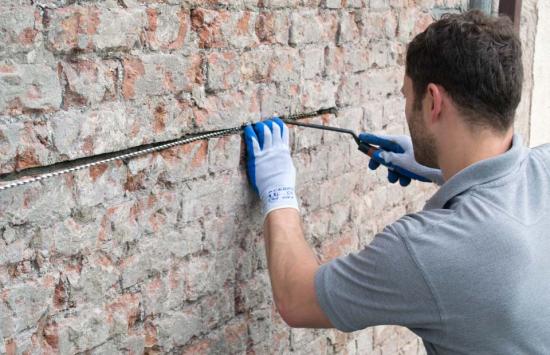
Structural cracks in walls are common in UK buildings. Many are harmless and relate to plaster shrinkage, thermal movement or minor settlement. Others, however, can be an early sign of structural movement, foundation problems or subsidence. For homeowners, surveyors, insurers and property professionals, the challenge is knowing when a crack is cosmetic and when it may point to something more serious. The pattern, width, location and progression of a crack all matter. Diagonal cracks around openings, stepped cracks in brickwork, recurring cracks after repair and cracks accompanied by sticking doors or uneven floors are among the warning signs that deserve closer attention.
Visible cracking should not be assessed in isolation. A crack is often a symptom of stresses within the structure, and those stresses may originate below ground. Structural cracks in walls need to be understood in relation to the building and the ground that supports it, which is why effective remediation should begin with diagnosis before repair.
What makes a crack more concerning?
Not all cracks indicate serious structural damage. Fine hairline cracks in plaster are often superficial. Straight vertical cracks can sometimes be linked to drying shrinkage or normal settlement. Structural cracks in walls become more concerning when they are diagonal, horizontal, stepped through masonry or continuing to widen. Cracks visible both inside and outside a wall, particularly when combined with distortion in openings or sloping floors, should be treated more seriously.
In many UK properties, the underlying causes of structural cracking include clay soil shrink-swell behaviour, leaking drains, washout of fines, poor fill, voids, differential settlement and long-term changes in moisture conditions. These mechanisms do not always produce the same visible damage, but they all underline the same point. Surface repair alone is rarely enough if the ground below remains unstable. Structural cracks in walls may return after patching when the source of movement has not been identified.
Why diagnosis matters more than assumption
In many UK properties, structural cracking can be linked to clay soil movement, leaking drains, voids, poor fill, differential settlement or long-term moisture changes. Surface repair alone is rarely enough if the ground remains unstable. Structural cracks in walls may return when the source of movement has not been properly identified.
Electrical Resistivity Tomography, or ERT, is a geophysical method used to model the subsurface and identify anomalies such as voids, weak zones, moisture concentration or changes in soil condition. As part of a wider investigation, it can support diagnosis and intervention planning, helping ensure that the chosen solution responds to the actual ground conditions rather than assumption.
A wider ground engineering response
GEOSEC Ground Engineering’s technical approach can include both expanding resin injections and Groundfix micropiles, allowing the engineering response to be adapted to the building, the ground conditions and the structural requirement. Structural cracks in walls do not all arise from the same mechanism, and they do not all justify the same intervention.
Where shallow ground weakness, voiding or local loss of support are driving movement, resin injection can provide a minimally invasive means of improving the ground, reducing deformability and increasing support beneath existing foundations or slabs.
Where deeper load transfer or a different structural solution is required, pressure-driven micropiles may be more appropriate. Systems of this type are designed for restricted access, sensitive environments and technically demanding interventions, especially where low headroom, limited space, reduced noise, absence of vibration and minimal disruption are important project constraints.
From residential homes to more complex assets
Although cracking and subsidence are often discussed in the context of domestic housing, the same underlying ground-related issues affect a much wider range of assets. These can include industrial slabs, roads, heritage structures, lift pits, rail and infrastructure-related environments. Structural cracks in walls may therefore be part of a wider ground-related pattern that requires careful technical interpretation.
For UK stakeholders, this is increasingly important. Insurers, surveyors, loss adjusters, property owners and homeowners need decisions that are both timely and technically defensible. A specialist contractor can support this process by helping identify the cause, justify the solution and provide a clear basis for intervention.
Whatever the cause, cracks that are changing, recurring or associated with other signs of movement should not be left to develop unchecked. Early investigation helps distinguish between harmless cosmetic cracking and more serious structural movement. It also reduces the risk of repeated patch repairs that fail because the source of the problem has not been addressed. Structural cracks in walls should therefore be assessed in relation to their behaviour over time, not only their appearance at one moment.










Leave a comment